
A Question Worth Chasing
My brother is a public defender in one of the most crime-ridden cities in the country. For years, he’s told me about cases that didn’t sit right with him. A mistake by an attorney, a misreading of the facts, a bad call somewhere in the process, and someone loses years of their life. Once in a while, he’d describe a case, and you could tell he was turning the same question over: Would this have gone differently in front of another judge, with another lawyer, in another county?
A lot of those cases weren’t his. Different jurisdiction, nothing he could file on or appeal. He could only watch and wonder how often the same thing was happening everywhere else.
We talked about it a lot. Like most lawyers, he had stories. But a story only tells you a problem exists in one instance. It can’t tell you whether you’re looking at something systemic. The question that eventually stuck with me was simpler and harder: If there were patterns buried in the justice system, how would anyone ever see them?
So I went looking at the data.
I started with state prison data, looking for people serving sentences wildly out of proportion to what they’d actually done. That’s harder than it sounds. There’s no national standard, and the same felony label can mean very different things from one state to the next, so the labels couldn’t be trusted. In Alabama, for example, Class D is the lowest rung on the felony ladder, created in a 2015 reform to divert low-level nonviolent offenders like drug possession and small-dollar theft away from prison. I had to compare what people actually did, not what each state happened to call it.
That small question got big fast. Every answer raised three more questions. Were these outcomes typical? Consistent from one county to the next? Were there counties that looked nothing like their neighbors? Were there judges whose sentencing stood out from everyone around them?
The Real Risk
The hard part was never finding data. There’s an enormous amount of it. The hard part was figuring out which data actually mattered and whether it was complete enough to trust. At 1Court, I’d already built a directory of every court in the country, so I knew where the records lived before I started. Every state I wanted to look at meant a different website, a different format, a different set of quirks. And the deeper I went, the clearer the real danger became: not missing a pattern, but convincing myself I’d found one that wasn’t there.
That made us obsessive about validation. More than once we were sure we’d found something, then realized we were looking at a data artifact instead of a justice problem. Every false start sent us back to the beginning and made the system better.
The first real breakthrough wasn’t a dashboard or a model.
It was Casey.
Casey
Casey is a mother who was serving what looked like a badly excessive sentence for a Class D felony. She wasn’t my brother’s client. She wasn’t even in his county. She surfaced in the early research while we were trying to figure out whether unusually long sentences for low-level offenses were real or just noise.
My brother looked into it. On his own time and his own dime, he drove across Alabama, pulled records, met the people involved, and helped get her released.
Until then, this had mostly lived in my head as an interesting problem. Casey was the moment the data turned into a person walking out of a prison. It was proof that there are people sitting inside these datasets whose cases will never get a second look unless someone goes looking.
That was enough for me.
Introducing Justice Audit
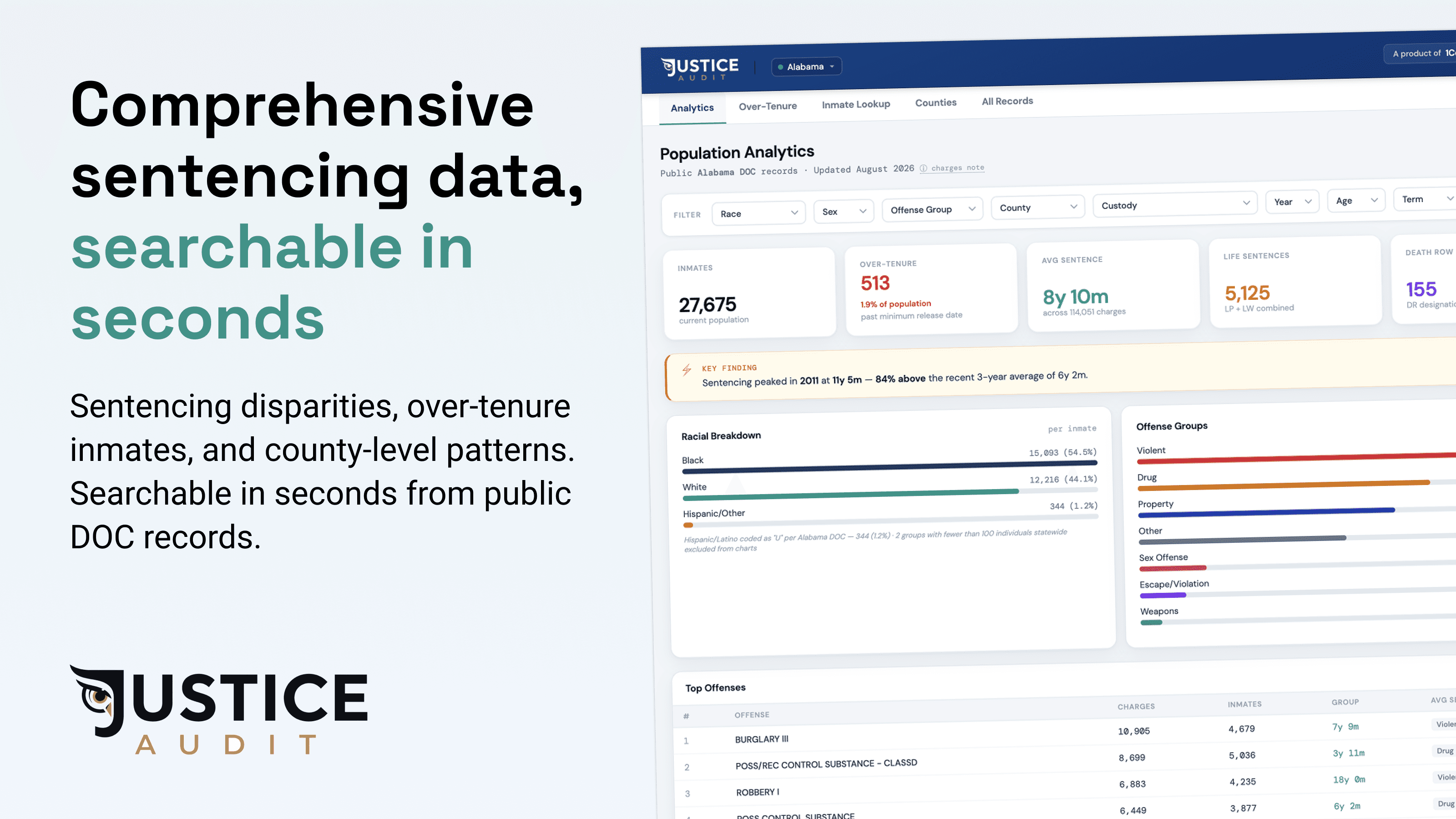
Those early experiments became what we now call Justice Audit. It analyzes criminal justice data to flag cases that may deserve another look. It doesn’t rule on whether a sentence was lawful, and it isn’t a substitute for a lawyer. It points to cases, patterns, and anomalies a human would otherwise never have the time to notice.
I’m Not an Engineer
Here’s the part that still surprises me. I’m not an engineer. I’m a product leader with a lot of experience in legaltech. I know the court system, but I’ve never been a coder per se. I built most of Justice Audit by vibe coding, describing what I wanted in plain language and letting AI write nearly all of the code. But vibe coding isn’t hands-off. On the scrapers especially, I had to play backstop. Left to its own logic, and with the tools available at the time, the AI could have walked us both off a cliff without either of us noticing, confidently producing data that looked clean and wasn’t.
Catching that didn’t take the ability to write the code. It took years as a product manager working alongside developers, and knowing the court data well enough to feel when a result was wrong. The AI did the part that used to take an engineering team. I did the part that keeps an engineering team honest.
A few years ago, a question like this needed real funding and years of runway. Now a couple of people with the right domain knowledge and the patience to iterate can interrogate questions that used to require an institution.
Results So Far
It’s still early even though Justice Audit is now in several States. The data isn’t clean, the methodology keeps changing, and every finding still comes down to human judgment, legal expertise, and investigative work that doesn’t scale. But it’s starting to work the way I hoped. We’ve helped get over a dozen people released now, the most recent just this week. Alabama has 67 counties, and the county-comparison analytics we’d just built surfaced a stark gap between them: one man was the only person in the state still denied parole for an offense that had freed others, county after county. My brother put that disparity in front of a judge. The judge agreed. The man went home.
Two Kinds of Work
My part in this has never looked like my brother’s. I think about data and systems and how to find the cases worth a closer look. He does the actual work: reading the files, making the calls, sitting across from families, figuring out whether there’s really something there. Most of these people aren’t his clients and aren’t in his jurisdiction. He has no reason to get involved except that he keeps deciding to.
If I’ve taken one thing from all of this, it’s that the people closest to a problem don’t have to settle for describing it anymore. They can build the tool that goes and investigates it.
That’s what happened here. It started with a public defender who couldn’t shake a handful of cases. Everything else came after.